Soil Microbiology & The Rhizosphere
The microscopic foundation of all terrestrial agriculture. A complex, living ecosystem governing nutrient cycling, disease suppression, and the health of civilization itself.
Historical Overview
The Legacy Paradigm: Soil as a Static Medium
For the majority of the 20th century, the Green Revolution operated on a fundamentally mechanical and chemical understanding of agriculture. Soil was largely treated as a sterile, static substrate—an inert physical anchor for roots where synthetic nitrogen, phosphorus, and potassium (NPK) could be artificially injected to force crop yields.
While this chemical paradigm temporarily skyrocketed global food production, it initiated a catastrophic decline in topsoil vitality. Heavy tillage, monocropping, and chemical saturation systematically decimated the microscopic life within the soil. Stripped of its biological engine, the earth lost its structural integrity, leading to severe compaction, diminished water retention, and the global crisis of topsoil erosion we face today.
The Biological Shift: Unlocking the Rhizosphere
Modern agroecology has inverted this paradigm, recognizing that soil is not dirt, but a hyper-dense, living biological matrix. The epicenter of this underground economy is the rhizosphere—the millimeter-thick zone of soil immediately surrounding a plant's roots.
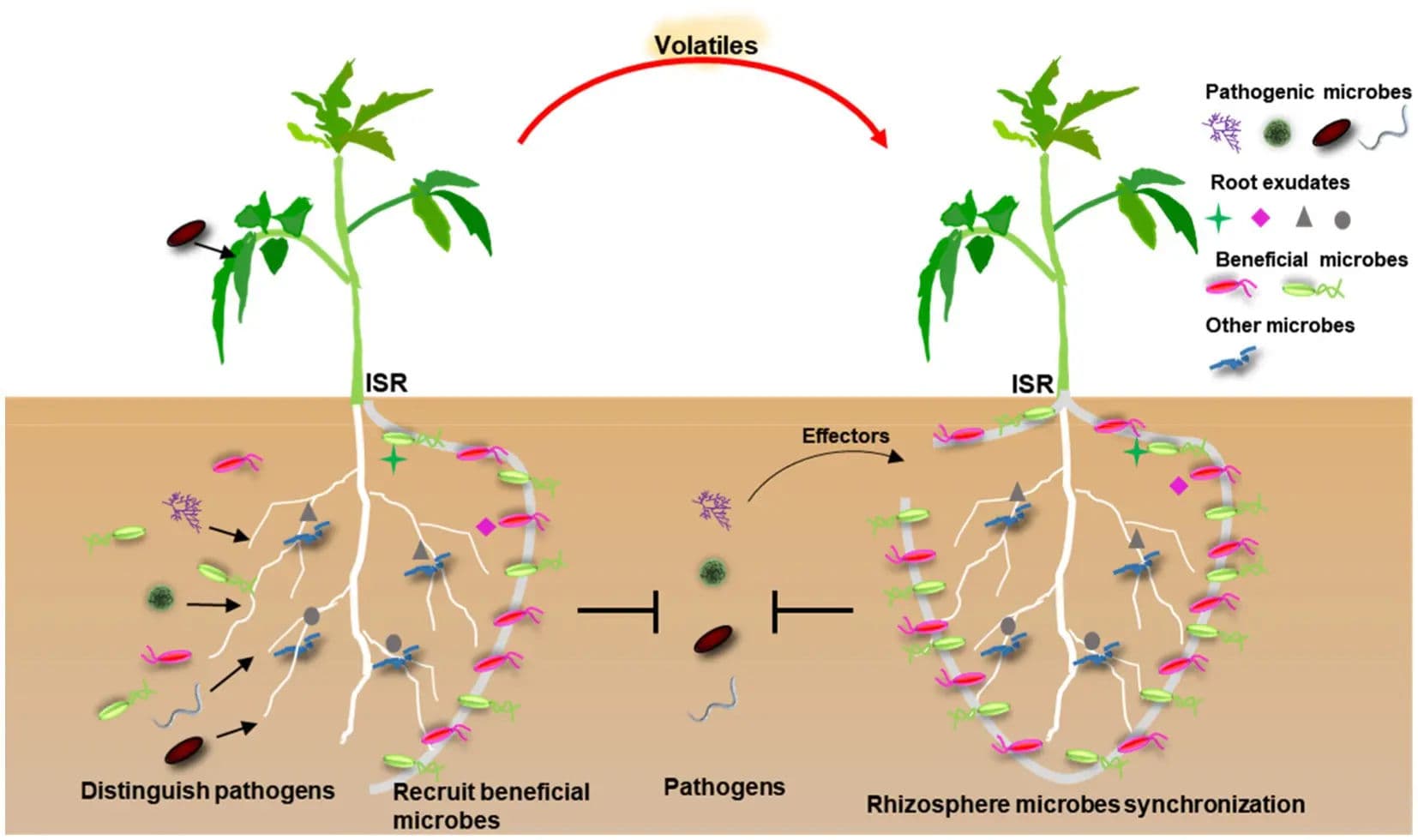
Plants are not passive consumers; they are active biological architects. Through photosynthesis, a plant can channel up to 30% of its liquid carbon energy straight down into its roots, releasing it into the soil as complex sugary compounds called exudates. These exudates are intentionally engineered to attract, feed, and cultivate specific colonies of bacteria and fungi. In exchange for this liquid carbon, the microbiome mines the surrounding earth, converting locked, inorganic minerals into bioavailable nutrients and delivering them directly to the plant's root hairs.
Core Biological Drivers: The Subterranean Economy
The resilience of an agricultural system relies entirely on the diversity of this microscopic workforce. Key biological drivers include:
- Arbuscular Mycorrhizal Fungi (AMF): These symbiotic fungi physically fuse with plant roots, extending microscopic threads called hyphae deep into the soil. This fungal network effectively increases the plant's root surface area by up to 1,000 times, allowing it to access water and phosphorus that would otherwise be completely out of reach. Furthermore, AMF secretes glomalin, a sticky glycoprotein that acts as a biological super-glue, binding soil particles into stable aggregates that resist erosion and act as massive carbon sinks.
- Plant Growth-Promoting Rhizobacteria (PGPR): Beyond the well-known Rhizobia that fix atmospheric nitrogen for legumes, a vast array of PGPR actively defend the plant. By rapidly colonizing the root surface, they physically outcompete pathogenic blights and fungi.
- Quorum Sensing & Induced Systemic Resistance: Soil microbes do not act blindly; they communicate through biochemical signaling known as quorum sensing. When beneficial bacteria detect an invading pathogen, they send chemical alerts that trigger the plant's innate immune system—a phenomenon called Induced Systemic Resistance (ISR). The plant pre-emptively fortifies its cell walls and ramps up defense enzymes before the pathogen even attacks.
Ecological & Economic Implications
The transition toward microbiologically focused agriculture—often termed regenerative agriculture—is the most viable pathway to secure the future of global food production. By minimizing mechanical tillage, utilizing multi-species cover crops, and eliminating broad-spectrum biocides, agronomists can restore the rhizosphere to its natural, highly efficient state.
Economically, fostering a healthy soil microbiome drastically reduces a farmer's reliance on expensive synthetic fertilizers and chemical pesticides. Ecologically, living soils act as a massive sponge, capable of holding tens of thousands of gallons of additional water per acre, buffering crops against severe drought. Most critically, deep-rooted symbiotic networks represent the largest active carbon sink on the planet, turning agriculture from a climate liability into a primary climate solution.